
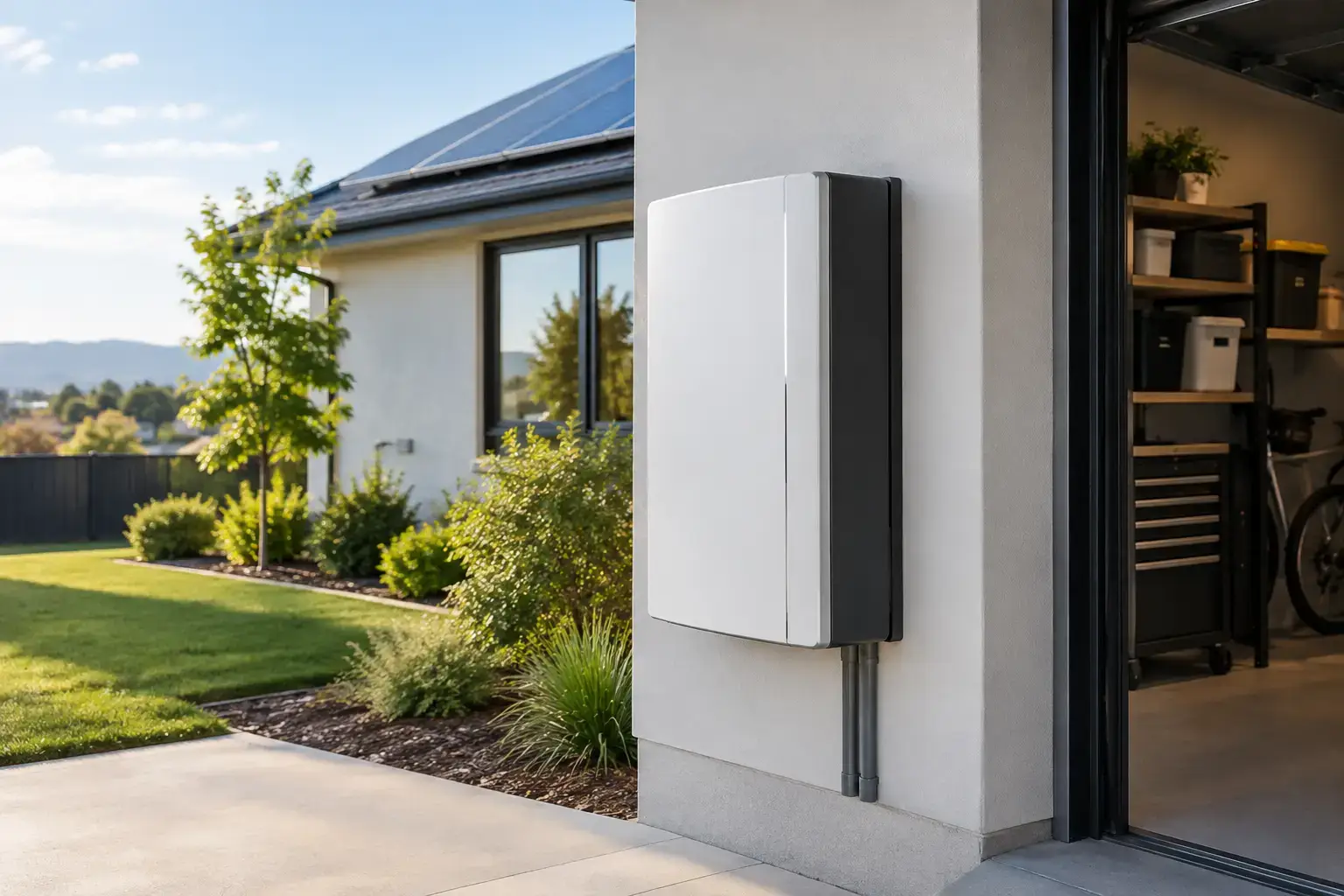
A battery that is too small can fill before lunch and leave little power for the evening. One that is too large may sit partly unused for much of the year, adding cost without delivering a proportionate return. Knowing how to size home battery storage properly starts with your real electricity use, not a rule-of-thumb figure or a neighbour’s system.
For most Cheshire households, the right battery is a balance between solar generation, evening demand, electricity tariff and the level of resilience wanted during a power cut. A properly specified system should be safe, tidy, fully tested and designed around the way the property actually operates.
Start with your daily electricity use
Your annual electricity consumption is a useful starting point, but it does not tell the whole story. Divide the annual total on your bill by 365 to find an average daily figure. A home using 3,650 kWh a year, for example, averages 10 kWh a day.
The more useful question is when that electricity is used. Battery storage is usually most valuable when it can capture surplus solar power during the day and release it after solar production falls. If your household uses 10 kWh daily but only 4 kWh occurs after sunset, a very large battery may not discharge fully on a typical day.
Smart-meter half-hourly data provides the clearest picture. It reveals the morning and evening peaks, daytime base load and seasonal changes that annual figures can hide. If that data is unavailable, a recent electricity bill, household routines and details of larger electrical loads still allow for a sensible initial assessment.
Match battery capacity to solar output
Battery capacity is measured in kilowatt-hours, or kWh. This is the amount of energy it can store. A 10 kWh battery does not necessarily provide a full 10 kWh for use, however. Manufacturers state usable capacity, which accounts for the portion held back to protect battery life and operation.
A useful starting point for a typical home with solar PV is to size the battery around the amount of surplus energy likely to be available on a fair-weather day. A modest 3.5 to 4 kWp solar array might generate far more than a household can use directly at midday in summer, while producing comparatively little on short winter days.
That is why a battery should not be sized purely to absorb the maximum summer output. A system designed only for July can be oversized for the rest of the year. Equally, a battery that is deliberately small may still be the better investment if it charges and discharges regularly across more months.
For many households, usable battery capacity in the region of 5 to 10 kWh is a sensible range to assess. Higher-use homes, properties with larger solar arrays or households using time-of-use tariffs may benefit from 10 to 15 kWh or more. The correct figure depends on the evidence, not on a standard package.
Consider future changes before specifying the system
An electric vehicle, heat pump, extension or growing family can change a property’s demand considerably. It is sensible to discuss likely changes before installation, particularly where the battery and inverter range can be expanded later.
An EV does not automatically mean the home needs a much larger battery. Charging a car from a domestic battery can deplete it very quickly, and it is often more economical to charge the vehicle directly from solar surplus or during a lower-cost tariff period. The battery’s role may be to cover the home’s evening load rather than attempt to supply every major appliance.
Capacity is only half the answer
When working out how to size a home battery, separate capacity from power. Capacity, measured in kWh, is how long the battery can supply energy. Power, measured in kW, is how much it can deliver at one moment.
A 10 kWh battery with a 3.6 kW output can theoretically run a 3 kW kettle, but not alongside several other high-demand appliances without importing additional electricity from the grid. Cooking, showers, immersion heaters, heat pumps and EV charging can create short peaks that matter as much as total daily consumption.
The battery inverter must also be correctly matched to the existing or proposed solar system. In an AC-coupled arrangement, the battery has its own inverter and can be added to many existing PV installations. A DC-coupled or hybrid inverter combines solar and battery management, which can be efficient for new installations but may require different equipment choices.
A site survey should check the consumer unit, earthing arrangements, circuit protection, cable routes and available installation space. Battery equipment needs a suitable location, appropriate clearances and a route that allows the installation to be completed neatly. Correct specification is as important as the advertised battery capacity.
Decide whether backup power matters
Many people assume a battery will keep the house running during a grid outage. In standard installations, that is not usually the case. For safety, solar and battery systems normally disconnect when the network supply fails, preventing electricity from feeding back onto lines being worked on.
Backup or emergency-power capability requires equipment designed for that purpose and a clear decision about which circuits will be supported. It may cover lighting, broadband, refrigeration and selected socket circuits rather than every load in the house. Electric showers, ovens and vehicle chargers are generally unsuitable for a limited backup supply.
If continuity matters for home working, medical equipment, refrigeration or security systems, raise it at the design stage. Backup provision affects the inverter choice, changeover equipment, battery power rating and cost. It should be tested on completion, not assumed because a battery has been fitted.
Use tariffs without overcomplicating the design
A battery can store low-cost electricity from an off-peak tariff and use it later when grid electricity costs more. This can improve the value of storage even in winter, when solar generation is lower. However, tariff charging should support a properly sized system, not justify fitting more capacity than the household can use.
The practical aim is often simple: charge from solar when there is genuine surplus, charge from cheaper grid periods when appropriate, and reduce imports during higher-cost morning and evening periods. The savings depend on tariff rates, export payments, household demand and the battery’s charging and discharging losses.
Check whether the system can be programmed around your chosen tariff and whether it provides clear monitoring. Good monitoring helps confirm that the battery is behaving as designed and makes it easier to adjust charging schedules as routines or prices change.
Allow for winter and real-world losses
A battery does not create electricity. During winter, solar output can be limited by shorter days, cloud cover and low sun angles. It may be sensible to grid-charge on a suitable tariff, but a battery sized for summer self-sufficiency will not make a typical North West home independent of the grid in January.
Round-trip efficiency also matters. Energy is lost as electricity is converted, stored and converted again. Battery age, temperature and the minimum state of charge reserved by the system will affect the usable result over time. Comparing quoted usable capacity, warranty terms, power output and control features gives a more realistic view than comparing headline kWh alone.
Get the electrical side checked properly
Battery storage is a significant alteration to a property’s electrical installation. The design needs to account for the supply characteristics, protective devices, isolation, earthing and the connection to the distribution network. Depending on the equipment and export capacity, notification or approval requirements may apply through the local network operator.
It is also worth checking that older consumer units and existing solar equipment are suitable for integration. Sometimes an upgrade is advisable to provide the correct protection and a clean, maintainable installation. A competent installer will explain what is required, complete the necessary testing and provide the relevant certification and handover information.
For homeowners in Northwich and the surrounding area, BMC Electrical Services NW assesses solar, battery and wider electrical requirements as one installation, rather than treating the battery as an isolated add-on. That approach helps avoid compromises in wiring, protection or future expandability.
The best battery size is the one that fits your normal routines, works with your solar output and tariff, and can be installed safely without cutting corners. Bring recent usage information and your plans for the property to the assessment, then let the design follow the evidence.