
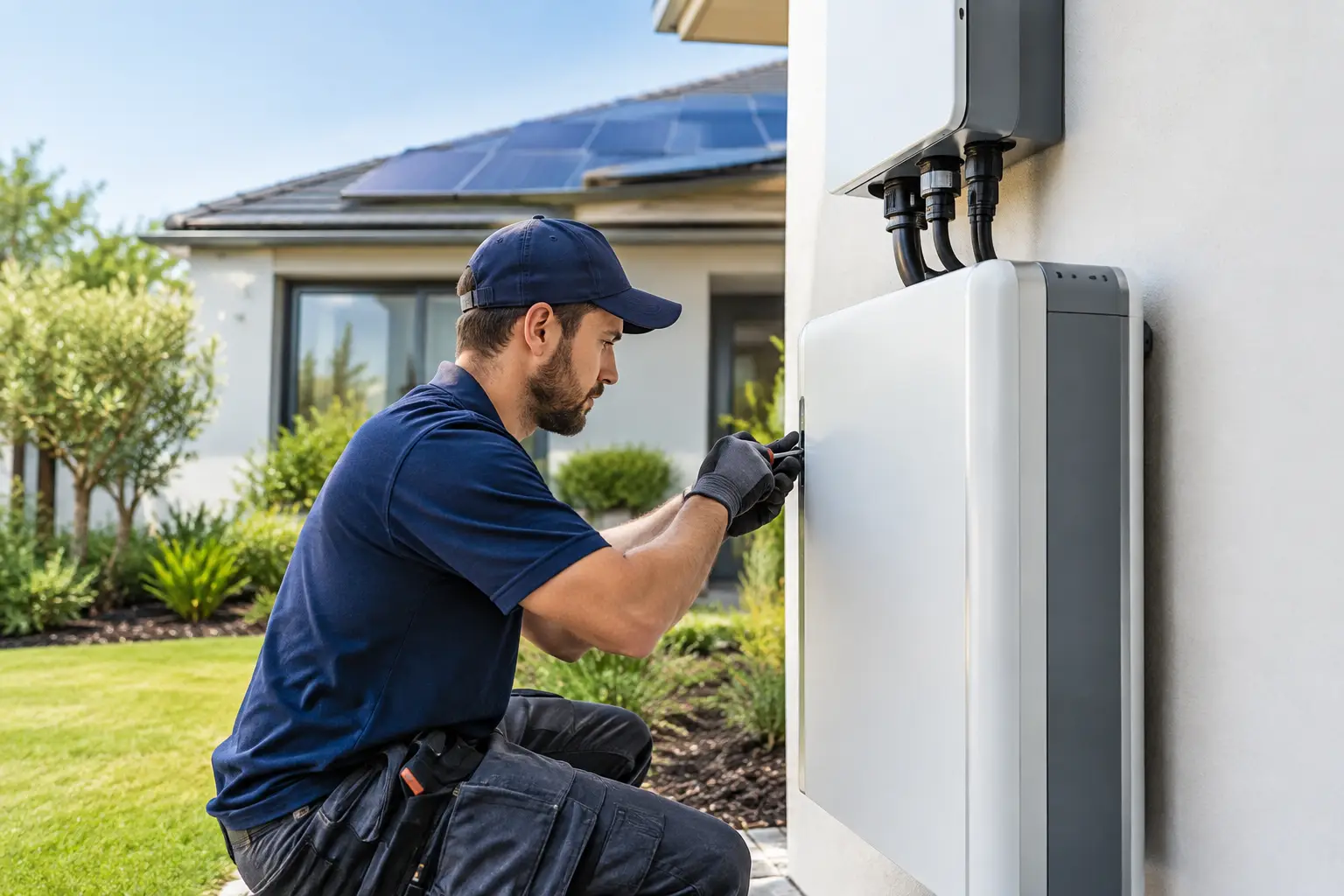
A battery that is too small can leave you buying electricity at the evening peak. One that is oversized may take years to earn its keep. That is why home battery storage installation cost is not just a question of finding the lowest price. The useful figure is the cost of a correctly designed, safely installed system that suits how your household actually uses electricity.
For many homes in Cheshire, a professionally installed battery system costs roughly £4,000 to £10,000 or more. The final figure depends on capacity, whether you already have solar panels, the type of inverter required, the condition of the existing electrical installation and the level of backup capability you want.
What does home battery storage installation cost include?
A clear quotation should separate the battery equipment from the work needed to install, protect, configure and test it. A battery is a substantial electrical addition to a property, not simply an appliance plugged into a wall socket.
The price normally includes the battery itself, an inverter or inverter connection equipment, isolation and protective devices, cabling, mounting, monitoring setup, commissioning and formal electrical testing. Where the system connects with Solar PV, the installation also needs to be configured so that generation, charging, export and household demand work together properly.
A straightforward battery added alongside a modern Solar PV system will usually cost less than a more involved retrofit. If an existing inverter cannot support battery storage, it may need replacing or the design may require an AC-coupled battery with its own inverter. Both are valid solutions, but they have different equipment and labour costs.
For eligible domestic installations, battery storage may be supplied and installed at the zero rate of VAT. This is worth confirming at quotation stage, particularly where the work forms part of a wider electrical or renewable-energy project.
The main factors that affect the price
Battery capacity and usable energy
Battery capacity is measured in kilowatt-hours (kWh). As a broad guide, a 5 kWh battery can cover a meaningful part of a modest household's evening use, while 10 kWh or more may suit a larger home, a household with higher consumption or a property aiming to store more solar generation.
The advertised capacity is not the only figure that matters. Usable capacity, warranty terms, expected cycles and output power all affect value. A lower-cost unit with limited usable storage may not deliver the same result as a battery with a stronger warranty and a better matched inverter.
Existing solar and inverter equipment
Homes with Solar PV are often well placed for battery storage because surplus daytime generation can be retained for later use. However, compatibility must be checked rather than assumed.
Some systems can accept a DC-coupled battery, which can be an efficient option when the right hybrid inverter is already fitted or being installed as part of a new solar project. An AC-coupled battery can work independently of the solar inverter and is often practical for retrofits. The right choice depends on the existing system, available space, expected energy use and future plans.
Electrical upgrades and cable routes
The battery may be the headline item, but the surrounding electrical work can change the installation cost. A modern consumer unit with suitable spare capacity can simplify the job. Older fuse boards, limited circuit capacity, poor access routes or a need for additional protection may add work.
Cable runs also matter. A battery positioned close to the consumer unit and inverter is generally simpler to install than one located across a garage, outbuilding or loft space. Equipment location must allow for manufacturer clearances, safe access, ventilation requirements and a neat route for cabling.
If an electrical inspection identifies issues that need attention first, dealing with them properly protects both the installation and the property. Cutting corners on earthing, protective devices or testing is not a saving.
Backup power requirements
Many battery systems reduce the electricity you buy, but they do not automatically keep every circuit live during a power cut. Full-house backup requires additional design work and equipment, and it may not be appropriate for every property.
A more focused option is an essential-load backup supply for selected circuits, such as lighting, broadband, refrigeration and a few sockets. This can be a sensible balance between resilience and cost. Heating systems, electric showers, ovens and other high-demand loads need careful consideration because batteries have limits on instantaneous power as well as stored energy.
Tariffs, EV charging and future expansion
A battery can charge from cheap off-peak electricity as well as from solar generation, provided the system and tariff are set up appropriately. This may improve the financial case for households with time-of-use tariffs, but savings depend on tariff differences, charging losses and daily demand patterns.
An electric vehicle, heat pump or planned extension can change those patterns considerably. It is often sensible to allow for future battery expansion, additional solar panels or an EV charger at the design stage, even if the work is not completed immediately. A system designed as part of the property's wider electrical plan is usually easier to develop later.
Typical price ranges for a home battery system
Every property needs its own survey, but these ranges give a useful starting point for budgeting:
- A smaller battery of around 5 kWh, fitted to a suitable existing solar installation, may fall around £4,000 to £6,000.
- A mid-sized system of roughly 8 to 10 kWh commonly sits between £6,000 and £9,000, depending on equipment and installation complexity.
- Larger systems, systems requiring inverter replacement, consumer unit work or backup provision can exceed £10,000.
- A new Solar PV and battery installation should be costed as one integrated design rather than by simply adding two headline prices together.
These figures are indicative, not a substitute for a site-specific quotation. Equipment quality, manufacturer warranty, system monitoring and the standard of electrical work all matter over the life of the system.
How to judge whether a battery is worth the investment
Payback is personal. A household that is empty all day, has low electricity use and exports little solar energy may see a different result from a family that uses power heavily in the morning and evening.
Start with half-hourly electricity data where available, rather than relying only on annual bills. Look at your daytime solar export, evening consumption, overnight base load and the tariff you are on. This shows how much energy is realistically available to store and when that stored electricity would be used.
Do not assume the largest battery gives the best return. If a battery regularly sits partly empty because there is not enough solar surplus or low-rate grid charging opportunity, extra capacity may not be productive. Equally, a very small battery may fill early and leave useful solar generation exported at a lower rate.
The best system size is usually the one that covers a worthwhile proportion of your regular demand without paying for capacity you will rarely use. It should also be selected with the battery's guaranteed usable capacity and warranty in mind, not only its headline specification.
What a proper installation should look like
A battery installation should begin with a survey of the property, its existing electrical equipment and the intended location. The installer should discuss fire safety considerations, cable routes, access, loading requirements and how the system will behave in normal operation and during a grid outage.
Once fitted, the system should be configured, labelled and tested. You should receive the relevant electrical certification and clear information on monitoring, shutdown procedures and what to do if the system displays a fault. For Solar PV-connected work, the applicable network notification or approval process also needs to be handled correctly.
Neat workmanship matters here. Clearly routed cables, correctly sized protective devices and accessible isolators make the system safer to use and easier to maintain. This is especially valuable where a battery is installed in a garage, utility room or plant area shared with other services.
Questions to ask before accepting a quote
Ask how much usable capacity the quoted battery provides, whether it can be expanded later and what warranty covers both the battery and inverter. Confirm whether the system is AC or DC coupled and why that approach is appropriate for your property.
It is also worth asking what is included for consumer unit alterations, monitoring, commissioning, certification and network paperwork. If backup power is important, ask exactly which circuits will remain live and for how long under a realistic load. A quote that answers these practical questions is easier to compare than one based on battery size alone.
For homeowners in Northwich and the surrounding area, the right starting point is a site survey that considers solar generation, household demand and the condition of the existing installation together. A well-specified battery should feel like part of the home’s electrical system: safe, tidy, fully tested and ready to earn its place every day.