
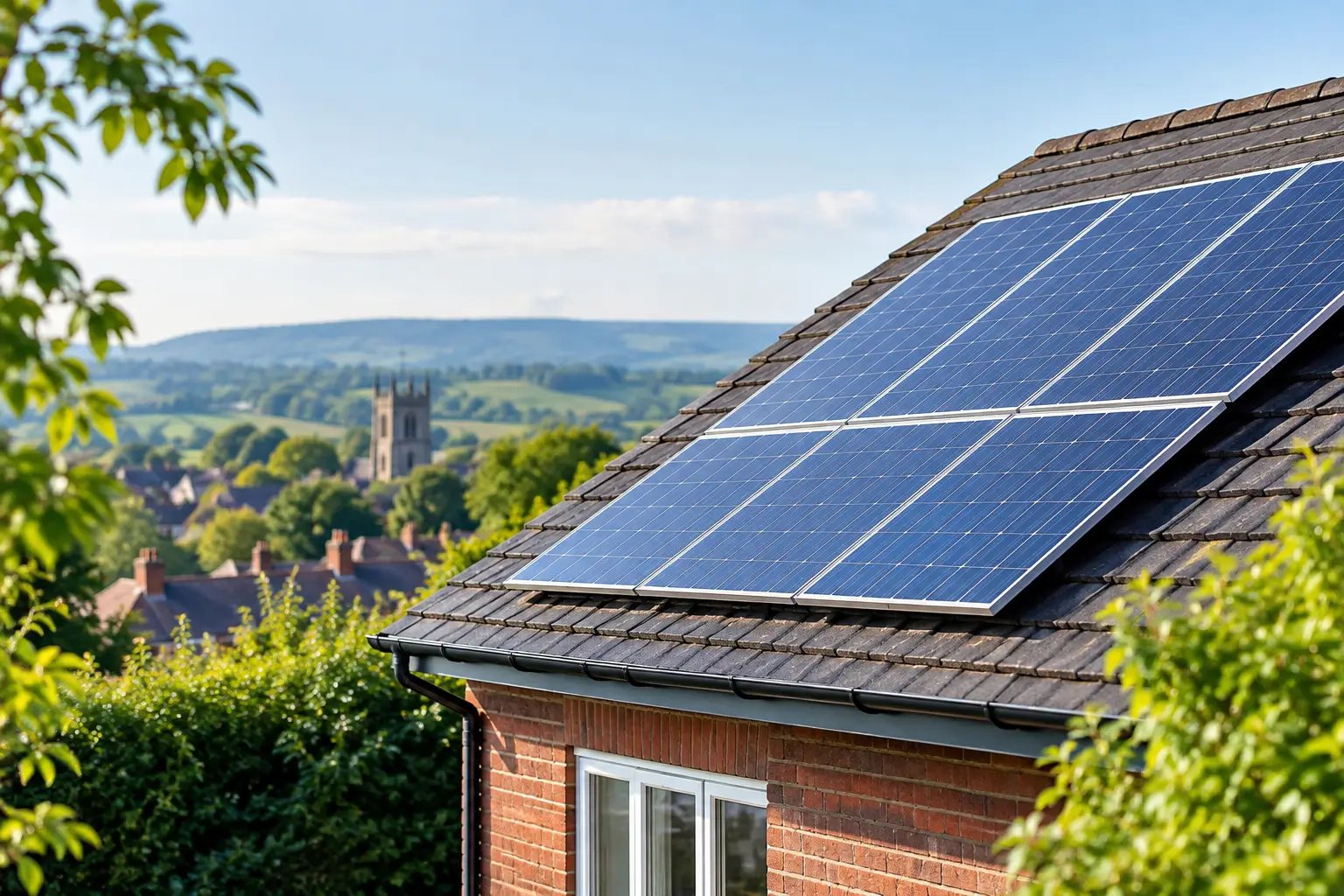
A solar survey can reveal a roof with excellent south-facing space, strong generation potential and room for a battery - but it can also uncover a planning constraint that needs dealing with first. So, do solar panels need planning permission? For many homes in England, the answer is no, provided the installation meets permitted development rules. However, listed buildings, conservation areas, unusual roof designs and larger ground-mounted systems can change the position.
Getting this right before panels are ordered protects the project from delays, redesign costs and, in the worst case, enforcement action. Planning is only one part of a properly specified solar installation, but it should be checked alongside roof condition, electrical capacity, battery location and the grid connection process.
Do solar panels need planning permission on a house?
Most roof-mounted solar PV systems on houses fall under permitted development in England. This means a separate planning application is not normally required, as long as the system complies with the relevant limits and conditions.
For a typical pitched-roof installation, panels should not project more than 200mm beyond the plane of the roof, excluding existing features such as a chimney. They must not sit higher than the highest part of the roof, and they should be positioned to minimise the effect on the external appearance of the building where reasonably practicable.
These rules are why a careful survey matters. A standard array sitting close to the roofline will often be straightforward. A raised frame on a flat roof, a system on a complex roof with several levels, or panels proposed above a ridge line may need more detailed consideration.
Permitted development rights do not mean that any design can be fitted anywhere. The installation still needs to be safe, securely fixed, properly wired and electrically tested. Solar PV work should be planned around the condition of the roof, suitable cable routes, isolators, consumer unit capacity and the requirements of the local distribution network operator.
When planning permission is more likely to be needed
The quickest answer is that restrictions are more likely where the property has heritage status, sits in a protected area or requires a system that falls outside normal permitted development limits.
Listed buildings and protected locations
If a building is listed, listed building consent may be required even where the panels would otherwise be treated as permitted development. The impact on the character and fabric of the building matters, including fixing methods, cable routes and the visibility of the array.
Properties in conservation areas also need extra care. Roof panels may still be possible, but the position of the building and its relationship to a highway can affect what is permitted. The same applies to properties in other designated areas, where permitted development rights may be restricted.
Do not rely on a neighbour having solar panels as proof that your proposal is allowed. Their property may have different planning history, orientation, boundaries or heritage status. A local authority can also impose conditions that remove some permitted development rights on particular estates or developments.
Flats, leasehold homes and shared buildings
A householder’s permitted development rights do not automatically apply in the same way to flats, maisonettes or communal buildings. A block of flats, a converted building or a property with shared roof space can require a planning application or a different route through the planning system.
Leasehold homeowners should also check their lease before committing to an installation. Freeholder permission, management company approval or consent from other owners may be required, even if planning permission is not. This is a separate issue from planning, but it can be just as important.
Ground-mounted solar panels
Ground-mounted arrays can work well where a roof is shaded, too small or unsuitable for the required output. They are not simply treated as a roof installation placed at ground level, though.
Smaller standalone arrays within a home’s curtilage may be permitted development if they meet limits on size, height, position and number. There are further restrictions near boundaries, highways, listed buildings and conservation areas. A system that is raised high enough to clear a fence, covers a substantial garden area or is intended for commercial-scale generation is much more likely to need planning permission.
Before choosing a ground array, consider whether it will be overshadowed by trees, affect access, reduce usable garden space or create glare for a neighbour or nearby road user. The best technical location is not always the simplest planning option.
Commercial solar installations need a separate check
Planning rules for commercial and industrial premises are different from those for houses. Many roof-mounted systems on warehouses, offices, farms and other non-domestic buildings can be installed under permitted development, but the relevant limits are not identical.
The height, projection and visual impact of the panels all need assessing, particularly on flat roofs and larger buildings. A commercial project may also involve plant such as inverters, battery storage equipment, switchgear or mounting systems that need to be included in the overall design review.
For businesses, planning is only one approval stream. Grid connection arrangements, export capacity, fire safety considerations, structural calculations and landlord consent can all affect programme and cost. Facilities managers should involve their electrical contractor early, rather than treating solar as a standalone roof project. The finished system must work safely with the building’s existing supply, distribution equipment and operational demands.
Planning permission is not the only approval to consider
A solar installation can be planning-compliant and still require other checks before work starts. The main areas are building control, electrical compliance and grid notification.
Solar PV work is notifiable electrical work in many domestic situations. It should be designed, installed, inspected and tested by a competent installer, with the correct certification issued on completion. If a consumer unit is older, lacks space, or has unsuitable protective devices, upgrades may be needed before the solar system can be connected safely.
The local electricity network also needs to be considered. Smaller domestic systems are often notified after installation under the applicable connection process, while larger systems or those with significant export capacity may need approval before connection. Battery storage, EV charging and heat pumps can increase the need for a wider assessment of the property’s electrical supply.
Planning approval does not replace any of these obligations. Equally, electrical certification does not confirm planning compliance. They are separate checks that need to line up.
A sensible way to plan a solar project
Start with the property, not the panel brand. A proper survey should assess roof orientation, shading, roof condition, available space and the route from the array to the inverter and consumer unit. It should also establish whether a battery would add value based on household consumption patterns and export arrangements.
Next, check the planning position before placing an order. For a straightforward house in Northwich, Winsford or the wider Cheshire area, this may be a confirmation that permitted development applies. For a listed property, a conservation area or an atypical installation, it may mean speaking with the local planning authority or submitting an application before work is scheduled.
Keep a clear record of the proposed layout, panel dimensions, mounting method and property status. This gives the installer, planner and homeowner the same starting point, and it reduces the risk of a design changing late in the process.
Finally, allow the electrical side of the job to be designed properly. The neatest panel layout is of little use if cable containment is poorly planned, protective devices are incorrectly specified or the consumer unit cannot safely accept the new connection. Solar should feel like a considered part of the property, not an add-on.
If there is any doubt, check the planning position before installation begins. BMC Electrical Services NW can help customers approach solar as a complete electrical project - safe, tidy, fully tested and properly wired from roof to consumer unit.