
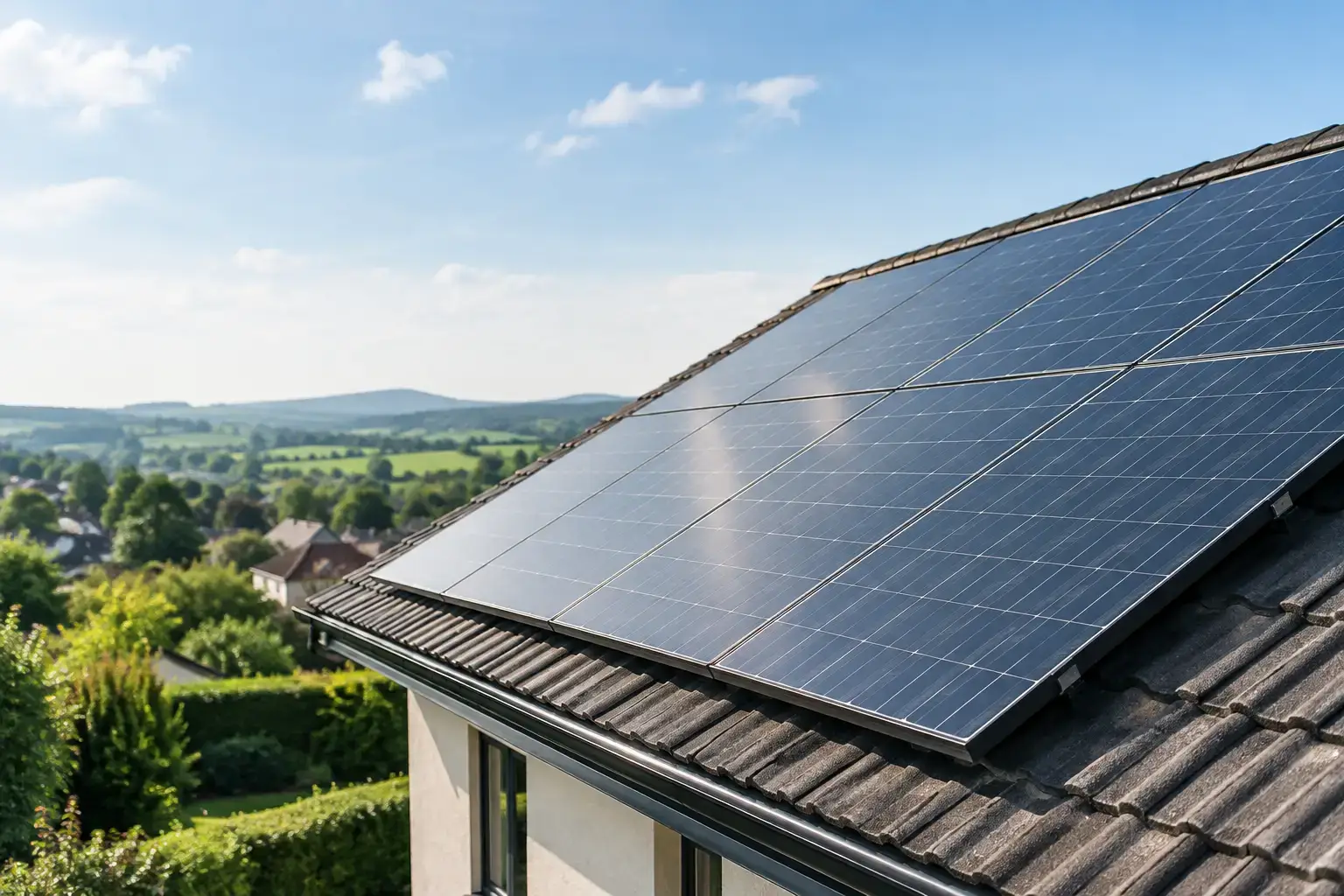
A solar system should earn its place on the roof and on the consumer unit. Cheshire solar panels can reduce the electricity you buy from the grid, but the result depends far more on sound design and safe installation than on a headline panel figure.
For homes and businesses around Northwich and across Cheshire, the right system starts with how the property uses power. A household that is empty for most of the day has different priorities from a busy family home, a workshop with daytime machinery or a site preparing to run electric vehicles. Looking at that demand properly is the difference between fitting equipment and specifying a useful energy system.
Cheshire solar panels start with the property
Roof direction is relevant, but it is not the whole story. A south-facing roof commonly provides strong generation across the day, while east- and west-facing arrays can produce useful power earlier and later. That may suit properties where electricity is used at breakfast, after work or across a working day.
Shade needs equally careful attention. Chimneys, neighbouring buildings, mature trees and roof features can affect output at different times of year. A survey should consider the actual roof layout rather than assuming every available square metre is productive. Panel placement, string design and, where appropriate, panel-level optimisation should be selected for the site rather than added as a default.
The roof itself must be suitable too. Its condition, covering, access and available fixing points all matter. It makes little sense to install an array over a roof that will shortly need significant repair. Good installation work protects the building as well as producing electricity.
What a properly specified system includes
Solar PV is not just a set of panels. It is a connected electrical installation that needs to work safely with the property’s existing supply and circuits. A proper survey considers the roof, the generation equipment and the condition of the electrical installation together.
A well-planned system will normally account for:
- the number, output and orientation of the panels;
- the inverter capacity and a suitable location for it;
- cable routes that are safe, protected and kept as tidy as practical;
- the consumer unit, earthing arrangement and protective devices;
- grid connection requirements and the required notification or application process.
The inverter changes the panels’ direct current into usable alternating current. It should be correctly matched to the array and installed where it can be safely accessed, ventilated and maintained. Cables should be properly supported and protected, not treated as an afterthought once the panels are in place.
The existing consumer unit also deserves close attention. Older boards, limited spare capacity or unsuitable protective devices may mean associated electrical work is needed before solar can be connected correctly. This is not needless extra work. It is part of ensuring the system is safe, compliant and fully tested when complete.
Grid connection is part of the job
Most domestic solar systems export surplus generation to the network when the property is not using it. The network operator must be notified, or approval obtained in advance where the proposed connection requires it. The exact route depends on the size and specification of the system.
That process should be handled clearly, with the customer understanding what is being installed and what paperwork will be provided. Electrical certificates, test results and commissioning information are not administrative extras. They provide evidence that the installation has been completed properly and give a useful record for future work, property sales and fault finding.
Should you add a battery?
A battery can store electricity generated during the day for use later, rather than exporting all of the surplus immediately. For many households, that can increase the amount of solar power used on site. It may also allow charging during lower-priced tariff periods where this suits the household’s electricity arrangement.
It is not automatically the right choice for every property. Batteries add capital cost, take up space and have a finite usable capacity. Their value depends on generation, the pattern of electricity use, the tariff and whether the owner is prepared to manage charging settings sensibly.
A property with high evening consumption, an electric vehicle, a heat pump or regular daytime solar surplus may have a strong case for storage. A lightly used property with modest consumption may be better served by solar alone initially, provided the system has been planned so a battery can be considered later.
Backup power is another area where assumptions cause disappointment. Not every battery keeps a property running during a power cut. If backup capability matters, it needs to be designed as a specific function, with suitable changeover equipment and clearly agreed circuits. A battery that simply stores solar energy is not necessarily a whole-house backup system.
Matching generation to how you use electricity
The best return from solar generally comes from using more of the electricity on site. Timers, smart controls and sensible routines can help shift flexible demand into daylight hours. Running appliances, charging an electric vehicle or heating stored hot water when generation is available may improve the value of the system.
There is no need to turn daily life upside down. The aim is to understand which loads can move without inconvenience. A family home may benefit from scheduling a dishwasher or washing machine. A business may already have useful daytime demand from lighting, IT equipment, refrigeration, ventilation or machinery, making solar particularly relevant.
For commercial premises, the design conversation should include operating hours, peak loads and future expansion. A business planning additional EV chargers, electric heating or new equipment may need a wider electrical strategy rather than a solar installation considered in isolation. Solar, battery storage, distribution upgrades and charging infrastructure can be planned to work together.
Cost, savings and realistic expectations
Solar output changes with season, weather, shading and the orientation of the array. Electricity prices and export payments can also change. For those reasons, responsible estimates should be treated as informed projections, not guaranteed savings figures.
The most useful question is not simply, “How many panels can fit?” It is, “What system suits this property and its likely electricity use?” A larger array may generate more overall, but it is not always the most sensible answer if there is limited roof space, substantial shade or very low demand.
It is also worth considering future plans. An upcoming kitchen refurbishment, extension, electric vehicle or heat pump can change a property’s electricity profile. Allowing for likely changes at the design stage can avoid unnecessary alteration later. Equally, there is no benefit in paying for capacity that has no clear purpose.
A tidy installation with proper testing
Solar work combines roofing coordination with electrical installation. Customers should expect a clear plan for access, cable routes, equipment positions and any disruption to the supply. At completion, the site should be left orderly, with equipment labelled and the system explained in plain language.
Testing matters at every stage. The panels, inverter connection, protective devices and associated circuits all need appropriate checks before handover. If remedial work is required on the consumer unit or existing circuits, it should be identified clearly rather than concealed behind a new installation.
For landlords, developers and facilities managers, this approach is particularly valuable. A documented, tested installation supports compliance records and makes ongoing maintenance simpler. For homeowners, it provides confidence that the equipment generating power on the roof has been connected safely inside the property.
Choosing an installer for solar PV in Cheshire
Ask how the installer will assess shading, roof layout, existing electrical equipment and your typical electricity use. Ask what documentation and test certification will be supplied, how the network connection process will be managed, and what support is available after commissioning.
A good answer should be clear rather than overly complicated. You should know where equipment will sit, what work is included, whether the consumer unit needs attention and how to monitor the system once it is running. Clean workmanship and proper cable management are practical signs that the rest of the installation has been treated with the same care.
BMC Electrical Services NW approaches solar as part of the wider electrical installation: correctly specified, safely connected, tidy on completion and fully tested. That matters whether the project is a straightforward domestic array or part of a larger plan involving battery storage, EV charging and electrical upgrades.
The right solar system is not the one with the most impressive specification on paper. It is the one that suits the building, supports the way you use electricity and has been installed properly enough to give confidence for years to come.